Showing posts with label Akashvani. Show all posts

Monday, 23 May 2016

‘Education-- ultimate way to bring Tribal Population to fore’ feels Union Minister of Tribal Affairs, Jual Oram.

As the NDA government celebrates two years of Governance later this month, All India Radio is chronicling their work through special series #SewaKeDoSaal.        
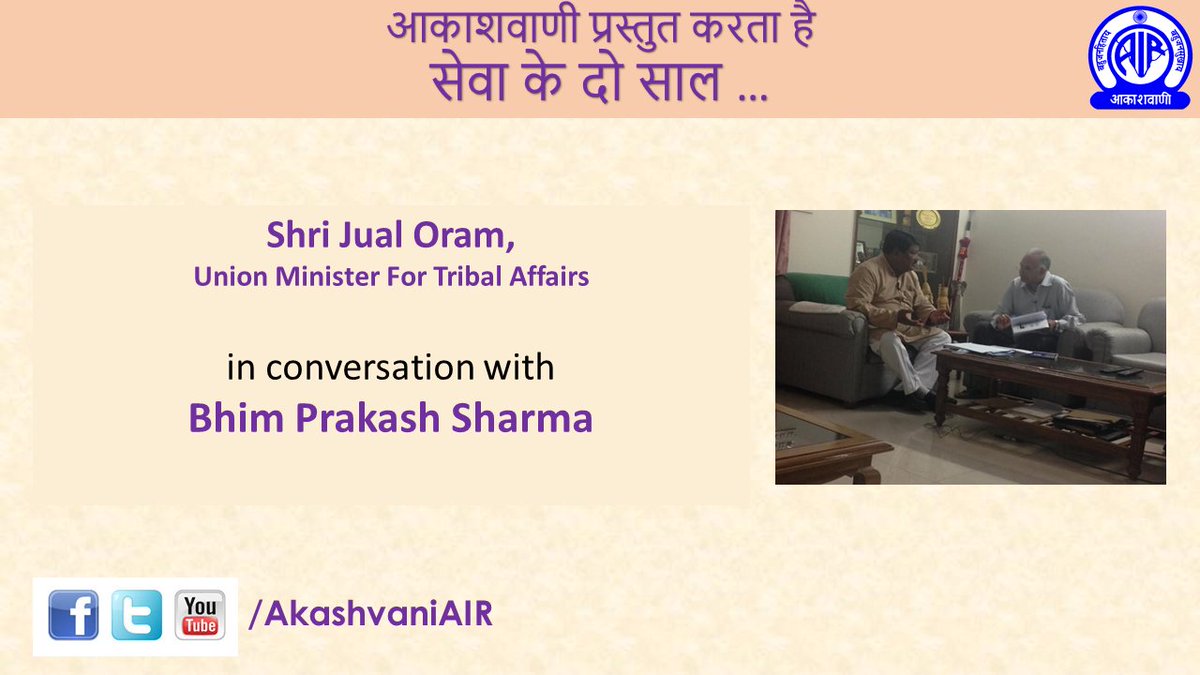
Today on 23 May 2016, we dissected the work of Tribal Affairs Ministry and brought in our courtroom Shri Jual Oram, Union Minister for Tribal Affairs, interviewed by AIR Programme Executive Shri Bhim Prakash Sharma 
Jual Oram started the session on a positive note and emphasized “Education is the ultimate way to bring the tribal population into the mainstream”. In his short and crisp interview, he eloquently spoke over matters related with the development of Tribal in India

·       With proper encouragement and guidance, students of tribal origin have come at par with general category students and a good percentage have enrolled for Engineering and Medical fields.

·       State Governments are running hostels and Jawahar Navodaya Schools to encourage students for education.

·       Employment is another arena which is properly addressed. With organisation named Tribal Co-operative Marketing Development Federation of India Ltd (TRIFED), proper help is provided as people gain Minimum Support Price (MSP).

·       Various vocational training programmes have been started to infuse confidence and make them understand the market demands.

·        Proper platform is provided to promote their arts, crafts and produce of the farmers in cities.

·       Besides Mobile Dispensaries and Medical Vans, there are voluntary organisations as Ram Krishna Mission, Bharati Sevashram and Vanvasi Kalyanshram.

·        Some common ailments like anaemia, malaria and other diseases are systematically addressed with our tie ups with the Ministry of Health and several other pharmaceutical organisations.

·       Regional workshops and seminars are encouraged by the Ministry in order to infuse in the minds of the tribals, a deeper understanding and awareness about the importance of education.

·       We are doing every possible effort to encourage the players, special hostel facilities and other assistance is given to them so as to encourage both traditional and mainstream games.

·       The tribal population have largely benefited with the Pradhanmantri Jan Dhan Yojna. For better coordination we have established Tribal Advisory Committee in order to maintain better coordination with the other ministries.

·       Akashvani has been of greater help throughout the process, as it has a wider reach and deeper penetration and assists us to broadcast awareness and educational initiatives.  

At the end the Minister leaves with the message that how Prime Minister Narendra Modi ji is working towards inclusion, and that’s possible only when we work together and act together, so now it’s time for us to work towards rural and tribal development and empowerment and further help built a better India for its tribal population and other citizens as well.


You can listen to the complete interview on the below mentioned link:

https://www.youtube.com/watch?v=Hk8UZnhQ80o&feature=youtu.be&a


Thursday, 19 May 2016

The Odissi Angel dancing over the 'Waves'


In the day and age when people are gradually shifting to ‘popular’ dance forms like Jazz, Salsa, Western and Hip-Hop amongst others , Shamayita Das a Transmission Executive from All India Radio, Jaipur, stands out by keeping the age old dance form of Odisha alive.
Here are a few excerpts from her conversation with Sami A. Khan:
     
1    From the little girl of 10 who executed her first perfect tribhang to the accomplished dancer of today who is happy doing chauk, tell us about the evolution of the dancer in you.

 A .     Dance has been the essence of my life. The reason of my very being in this world. This pursuit would have been impossible without the sacrifice of my mother, and my guru Padmashri Smt. Madhavi Mudgal’s mentorship. Apart from my keen interest in dance, it was my Guru who influenced me to the extent that dance is now a passion, dedication, love and salvation. Here I would like to quote my guru- “you should be able to enjoy your pain and only then you can be a true dancer!”

2     In the era of Bollywood fusion and remixes, tell us about the relevance of classical dance forms.

A. Since time immemorial dance has been a way of manifesting the innermost depths of the soul. It depends on what type of dance form one chooses to express their self. It can be anything – Bollywood, western, jazz, or classical.

Though the world has attained a faster pace, and this is an era of crash courses and expectations have increased manifold, yet classical dance or music still retains its charm amongst its connoisseurs. Senior dancers passed on the knowledge through Guru Shishya Parampara. It is on us how successfully we pass on the tradition of classical arts to our next generation. For this we must make good use of social media, administration and academics. Awareness in this regard has increased to an appreciable extent and nowadays we do see organisations and senior dancers conducting workshops and demonstrations for the propagation of their respective dance forms. Its relevance will never be lost as this is our country’s heritage – and this heritage cannot be tarnished by any means.

3   Why did you also insist on pursuing academics when dance already had a bright future in store?

A .    Academics is indispensable. Without knowledge art remains somewhat incomplete. For me, the understanding of basic principles underlying movement like momentum, inertia, torque, have been helpful in honing my dancing skills. It helps to understand the body and the mind better. You become a better person and a better artiste. Though I had early exposure to this glamour-laden world still I did not compromise on academics as it always supplemented my art and dance provided me the necessary impetus for rejuvenation. I owe whatever I’m today both to dance and academics. Because of academics I am financially independent, and dance has contoured my identity.

4     Was this an easy path? Tell us about your struggles, your trials and tribulations, as you tried to do what was closest to your heart? 

A. Well, this goes without saying that nothing comes without a price. As a child of then, I used to travel 56 kms, thrice a week from Faridabad to I.T.O. to learn dance. I was not only pursuing my favourite art form, but my Guru was a strong motivator. Needless to say that the never ending saga of exams and performances kept me on my heels throughout. When others were playing or relaxing, I was already enroute to a practice session. There had been testing times, but unceasing dedication to my art form, devotion for my Guru, support of my parents, and faith in myself kept me moving. I have often heard parents say that it is difficult to pursue your passion whole-heartedly along with academics, but in Tagore’s words I would like to say that, “no knowledge in this life is unlearnt, and nothing goes waste who has the desire to fight.” 


Catch Shamayita Das’s mesmerizing performance
Today (19th May,2016) at India International Centre, New Delhi at 5 pm. 

Tuesday, 21 July 2015

Indian Broadcasting Day-23rd July 1923


Indian Broadcasting Day - 23rd July 1923


"Radio---harbinger of new hope and life".

"With the advent of efficient broadcasting - there is nothing to prevent, in time, the farthest confines of Kashmir, Sikkim or Travancore simultaneously receiving the news of the moment. Although by composition, ours is a commercial company, it is the earnest desire of the Board of Directors to do broadcasting in a spirit of public service.", said Sir Ibrahim Rahimtoola, Chairman of the Indian Broadcasting Company.


It was in June 1923, that the very first radio programme in India was broadcast by the Radio Club of Bombay (Mumbai) and then in November, 1923 from Calcutta (Kolkata). These radio broadcasts were made with the efforts of amateurs, later followed by private enterprise. 

This was the beginning, of a medium, which was to connect the country through electric waves and eventually contribute greatly in creating new India in new world order!

Finally, organised broadcasting in India began when the first station of the Indian Broadcasting Company (IBC) was inaugurated at Bombay by the British Viceroy of India, Lord Irwin on July 23, 1927. Though it gained a lot of popularity, but the Indian Broadcasting Company went into premature liquidation from March 1, 1930. Eventually, from April 1930, broadcasting in India came under the direct control of the Government.

In September 1935, broadcasting began in the princely State of Mysore with the name AKASHVANI. The name All India Radio was adopted from June 08, 1936 and the Delhi Station of the Indian State Broadcasting Service went on air on January 01, 1936 from the temporary studios at 18, Alipur Road.

Dr. Gopalaswamy Professor of Psychology at the Mysore University had set up a 30 Watt transmitter at his house to air the first broadcast in the year 1935. By the end of 1932 when the BBC started its Empire Service, the number of receivers in India was 8557. It increased to 10,872 by the end of 1933 & 16,000 by the end of 1934. Today, AIR covers 99.19% of total Indian population. It Broadcasts via DTH, live streams several AIR channels and updates through various social networking platforms.

National Broadcasting Day celebrates radio!


Thursday, 16 July 2015

AIR releases 3 volumes of Jagannath Bhajanavali as country gears for Jagannath Puri Rath Yatra

          It is a red letter day for the Central Archives of All India Radio as three volumes of Jagannath Bhajanavali rendered by renowned artistes of Odisha was released today by the Revered Gajapati Maharaja of Puri.

On this auspicious occasion, Shri S.C. Panda, Member (Personnel), Prasar Bharati , Sh. F. Sheheryar, Director General, All India Radio and Dr. (Smt.) Sudha Mishra, Deputy Director General (Archives) were present at the Maharaja’s Palace in Puri this evening.


During the first Nabakalebara mega event of the present millennium, the AIR Archives feels proud of airing mellifluous voices of those immortal celebrated artistes of Odisha who once had sung the most popular soulful and unique bhajanas five decades ago, dedicated to Parambrahma Lord Jagannath, titled as Shree Jagannath Bhajanavali comprising thirty bhajanas & jananas in three parts.


Friday, 10 July 2015

Ashadi Ekadasi--Pilgrimage on Foot

Akashvani Pune will continuously be among lakhs of people for 24x20 hrs for covering Ashadh Wari


“Ashadi Ekadasi—Pilgrimage on Foot”


Incredible India

Ashadi Ekadasi is a religious procession and is celebrated during the months of June- July (Aashaadh Shukla paksha). It consists of a beautifully decorated Palkhi having the “padukas” of the lord and the Palkhi procession consists of people collectively walking, singing and dancing the glory of the Lord in what are called as ‘Dindis’. This custom of taking out a holy procession is said to have started in 1810.

Displaying pandharpur-wari-yatra 05.jpg


Tradition has it that two of the greatest devotees of Lord from the Maharashtra state, Sant Jnyaneshwar and Sant Tukaram had set out on a pilgrimage to Lord Vittala from their respective places and reached the Divine Abode in fifteen days time on the auspicious day of Ashadi Ekadasi. Following this set tradition by these great souls, even after their merger with the Divine, devotees from the entire length and breadth of the state and even from outside the state set out for Pandharpur, wearing basil beads and singing His glory on a pilgrimage to reach on this auspicious day to have Divine Darshan. This pilgrimage is traditionally called Dindi Yatra. Commemorating this maiden Dindi Yatra undertaken by these great saints even today people from the state traditionally carry Padukas (divine sandals) of these great souls in palanquins on their procession to Pandharpur. Upon reaching Pandharpur on Ashadi, these devotees take a holy dip in the sacred River Chandrabhaga before proceeding for the Darshan of Lord Vittala.

Legend has it that Pundalik, an earnest devotee of Vithoba, placed the service of his parents higher than to that of God. He commanded the violent Bhima River not to disturb his sleeping parents. Pleased by his devotion, Lord Vishnu blessed him with a boon, and the river mellowed and now flows silently as the Chandrabhaga in Pandharpur. On appearing at Pundalik's doorstep, Vithoba found Pundalik with his parents sleeping with their heads on his lap. So as his parents do not get disturbed, Pundalik slipped a brick forward. Till date one finds Vithoba standing on that brick, waiting to be entertained by his 'host', at Pandharpur.
Displaying pandharpur-wari-yatra 03.jpg

The Palkhi procession has remained unbroken since it began  despite wars, famines and floods. More than Fifty Palkhis of saints assemble at Pandharpur every year. In Maharashtra “Varkaris” (predominantly simple farmers) is a big community. They usually undertake 21-day walk after they have completed the sowing process in their fields. In the Ashadi Ekadasi festival, people from every faith and religion participate. Learned sages also come for it. Jnyaneshwar preached the Gita which is considered the highest religious text in Maharashtra.

The 'Bhakti Marg' (the path of devotion) as propounded by Sant Jnyaneshwar, teach us to forget the physical self in pursuit of the Lord. When the Varkaris sing and dance during the pilgrimage, they forget the material world around them.

Displaying pandharpur-wari-yatra 02.jpg

Along with the Dindi procession, seva to the poor and needy is done reflecting that Lord is in all forms. This is called ‘Seva Dindi’. During the Seva Dindi, the people on pilgrimage undertake selfless service to the poor and needy like Amrut Kalash (Annadhan), Narayan seva, Medical seva, Building & repairing rural infrastructure etc.

Participation in Ashadi Dindi and Seva Dindi helps an individual in many ways by bringing good health, peace & prosperity in his life. Chanting the continuous glory of the God in the Ashadi Dindi procession and Seva Dindi purifies an individual, there is an inner cleansing that takes place in Mind, Body and Spirit and the participants tend to lose their individual identities and experience bliss. It develops all aspects of human personality and helps us understand the true purpose of Life.

Wednesday, 24 December 2014

Former PM Shri Atal BIhari Vajpayee
at an AIR children's
programme recording in 2000

F. Sheheryar,
DG, AIR


ATAL, THE AJAATSHATRU
                                                                      (AIR captures facets, some of them little known)


Atal Bihari Vajpayee, freedom fighter, parliamentarian, Prime Minister, visionary, poet, indeed a multi-faceted personality, is a name to conjure with when one is talking about world leaders that left an indelible mark on history of nations and world leaders. 
              
            Atal Ji, as he is fondly called, is enemy to none, a quality that endeared him to the people at large.  As a true karmayogi, he focused on development per se rather than politicizing development which tends to impede progress.  His style of good governance – unobtrusive and yet effective – had an imprint of his personality and is worth emulating by every leader irrespective of his/her political affinities and ideological predilections.  A grateful nation is observing the 25th December as the Good Governance Day.

Eradication of illiteracy was another goal close to his heart and he contributed a lot to popularizing school admission through his own methods to arrest the drop-out level of children which created a nation-wide buzz----- ‘School Chalein Hum’.

            His vision in consolidating the Indian Diaspora and people of Indian origin to help the country making rapid strides on the path of development will always be remembered.  He was the one who hailed Mahatma Gandhi as the first Pravaasi Bharatiya who had returned to India to lead the freedom struggle.  India celebrates the Pravaasi Bharatiya Diwas every year, to rekindle the interest of all non-resident Indians and PIOs in addressing the problems that bedevil the country. 

            All India Radio is putting out a plethora of programmes over its vast national network on the occasion of the birth anniversary of Shri Atal Bihari Vajpayee.  The Organization, with its love for the legendary leader, has abandoned the beaten track to put out programmes in a style that is non-conformist and suited to the demands of modern sound Broadcasting and contemporary milieu.

            We wish him long life and many more years of guidance to us all.


This article is a contribution by F. Sheheryar, Director General, All India Radio