Wednesday, 21 May 2014

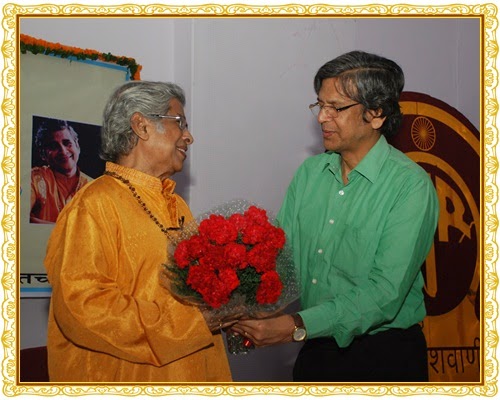
शाम की चाय-पंडित देवब्रत चोधरी के साथ

21 मई, 2014,को आकाशवाणी दिल्ली द्वारा 
प्रसिद्ध सितार वादक पंडित देवब्रत चोधरी के साथ "शाम की चाय",कार्यक्रम आयोजित किया गया.
प्रस्तुत हैं कार्यक्रम के कुछ दृश्य चित्रों की जुबानी

         पंडित देवब्रत चोधरी का स्वागत करते 
         हुए डी.डी.जी डॉ.लक्ष्मी शंकर बाजपई

                                         
श्रोतागण
श्रोतागण


        पंडित देवब्रत चोधरी का अभिनन्दन  करते 
         हुए डी.डी.जी डॉ.लक्ष्मी शंकर बाजपई

शास्त्रीय संगीत संध्या


20 मई ,2014 को आकाशवाणी दिल्ली द्वारा "शास्त्रीय संगीत संध्या" का आयोजन किया गया.
कार्यक्रम में प्रसिद्ध कलाकार -विद्वान् ओ.एस.त्यागराजन ने  कर्णाटक गायन तथा पंडित विश्व मोहन भट्ट ने  मोहन वीणा वादन प्रस्तुत किया.
प्रस्तुत हैं कार्यक्रम के कुछ क्षण चित्रों की जुबानी .


Tuesday, 20 May 2014

Prasar Bharati takes steps to 'immortalise' maestros


Prakash Kumar, New Delhi, May 19, 2014, DHNS:

Doordarshan, AIR asked to make biographic series on eminent artistes

The Prasar Bharati is set to embark on a project to immortalise over 60 maestros like Hindustani classical vocalist Pandit Jasraj and veteran playback singer Lata Mangeshkar along with their “signature performances”.

The public broadcaster has asked Doordarshan (DD) and the All India Radio (AIR) to make biographic video and audio series on the life and contributions of these eminent artistes, taking their interviews.

In a directive issued recently, the Prasar Bharati also urged the DD and AIR to record “lecture-demonstration” series with these unforgettable maestros as they would have “many things to share and impart to present and future generations.”

The move comes following a recommendation made by the Prasar Bharati Board in its meeting held in the second week of April this year.


The list of legendary artistes ear-marked for the archival series project include the names of noted Hindustani vocalist Kishori Amonkar, Karnatic vocalists M Balamuralikrishna and Nedunuri Krishnamurthy, composer M S Viswanathan, Karnatic flautist N Ramani, Sarangi player Ustad Sabri Khan and  Mridangam maestro T K Murthy.

Many of these legends were honoured as “national artistes” by the public broadcaster in 2004, while others were later recommended by the Prasar Bharati Board for being bestowed with the honour. Recordings of these iconic music artistes for the purpose of archives will be done simultaneously by the DD and AIR to ensure that the high-quality video and audio content is available to be aired by both of them.

The public broadcaster has asked the authorities to plan shooting of the performance and interviews of the artists keeping their health conditions in mind. “The artistes would be recorded, as far as possible, wherever they are based,” the public broadcaster advised.

The Prasar Bharati Board proposed that the artistes  be offered a consolidated fee of Rs 1.5 lakh for each recording, since the public broadcaster would own not just the broadcast rights, but also all other rights on the audio and video content prepared for archiving.

Saturday, 17 May 2014

Which is the oldest surviving newspaper in India?


Which is the oldest surviving newspaper in India? WhichIndian 
newspaper started publication at least three years before‘The Times’, 
London, and still continues? The answer to bothqueries would surprise 
many: ‘The Calcutta Gazette’, whichcompletes 200 year of publication 
today. 

The 1780s witnessed the birth, and unprecedentedadvancement of 
journalism in India. And Calcutta, as the capital ofBritish India, naturally 
took the lead. Though PortugueseMissionaries had brought the first 
printing press to Goa as early as1557, there was no newspaper or 
journal in India until January 29,1780 – whenJames Augustus 
Hickyventured to bring out hiscontroversial ‘Bengal Gazette’ from 
Calcutta. 

Hicky's two sheets of paper, about twelve inches by 
eight,contained enough advertisements for Hicky to prosper, but 
hisvitriolic columns caused so much indignation among the East 
IndiaCompany's ‘New Nabobs’ that the survival of India's first paper 
(andits proprietor) became a matter of considerable speculation. 
Theadministration of an exasperated Hastings finally clinched the issuein 
March, 1782, by seizing and closing down Hicky's press. Hickyhimself 
found his lodgings shifted to the Calcutta Jail. 

The Company's authorities were in favour of a Press thatwould be 
less ‘scurrilous’ and a trifle more understanding. BeforeHicky's Bengal 
Gazette completed 10 months, a rival paper calledthe ‘Indian Gazette’ 
was started by B. Messink, who was connectedwith the theatre, along 
with a salt merchant of Calcutta called PeterReed. India's second 
newspaper was promptly rewarded by WarrenHastings for its sobriety 
and loyalty with the privilege of circulationthrough the Post Office free of 
postage. The India Gazette did not,however, survive for long. 

The newspaper that did survive, and still does, was thethird –
thoughin its present form, it can hardly becalled a newspaper. The 
‘Calcutta Gazette’ was the brainchild of abrilliant individual; Francis 
Gladwin. A pioneering Orientalist andlexicographer, Gladwin was a civil 
servant who thought far ahead ofhis time. He was the first Professor of 
Persian at the Fort WilliamCollege in Calcutta, which Lord Wellesley had 
founded for theproper training of the Company's ‘griffins’ as soon as 
they reachedIndia. 

Francis Gladwin's translation of the Ain-i-Akbari reserved forhim a 
secure place among the assembly of Orientalists, while hisother 
translations from Persian, like the ‘Memories of KhojehAbdualKurrern’, 
the Tuti-Namah, Sheik Saadi'sGulistan, to name a few,continue to 
enthuse scholars. Gladwin's dictionary, the‘Compendious Vocabulary of 
English and Persian’, his ‘Ceremoniesof the Eastern Nations’ and his 
‘Vocabulary, Persian, Arabic andEnglish’ displayed his complete mastery 
over Persian Arabic,Hindustani and Bengali. 

Gladwin had to, of course, apply his genius to more 
mundanematters pertaining to revenue administration, and in this 
spheretoo, he has left ample evidence of his grasp, insight and 
labours.His contribution to, and his association with, the Asiatic Society 
– founded, incidentallyin the same year as the Calcutta Gazette – ispart 
of the Society's folklore. 

Gladwin had applied formally to "The Hon'ble GovernorGeneral & 
Council" on 2nd February, 1784, seeking sanction for thepublication of 
"A Authorized Gazette, under the ImmediateSuperintendence of a 
Covenanted Servant". The administrationmoved amazingly fast and 
within four days, the Secretary of theRevenue Department issued a 
notification declaring "Letter from Mr.Gladwin. February 2, agreed to in 
terms of his application". Theorder further enjoined upon the "the Heads 
of Offices to Issue allsuch Advertisement or Publication as may be 
ordered on the part ofthe Company, thro' the Channel of his Paper." 

Thus was born the Calcutta Gazette, on the 4th of March,exactly 
200 years ago, in Calcutta. Like its two forerunners, theCalcutta Gazette 
was also a weekly, but whereas the other twoGazettes were published 
on Saturday, this Gazette was publishedon Thursdays, and till today, the 
major publications of the CalcuttaGazette are bought out on Thursdays. 
One reason for this could bethat Muslim Assistants were difficult to come 
by on Fridays,whereas most Christians refuse to work on Sundays. This 
made thepublication of a paper that used Persian and English 
letterssomewhat difficult between Fridays and Mondays. But this is 
merelya supposition. 
  
‘The Calcutta Gazette’ or ‘Oriental Advertiser’ as it was 
called,started publication from 37 Larkins Lane, an off-shoot of Old 
CourtHouse Street in the Dalhousie Square area. Though Gladwin was 
acivil servant, "the official department of the paper was kept 
quitedistinct from the editorial, and the Company's authorities were in 
noway connected or identified with the management or politics of 
thepaper, but only used it as a medium for making known 
generalorders, requisitions, and official notices of all sorts". 
TheGovernment never regarded (until 1832) the Calcutta Gazette as 
itsofficial organ and often took umbrage at some of its comments. 
Infact, such displeasure was often made public through themedium of 
the same paper. On the 10th of February, 1785, anannouncement was 
made in the Gazette that the Governor-Generaland Council had 
expressed their entire disapprobation of someportion of the Gazette 
dated September, 30, 1784. 

Gladwin could not resist a swipe or two against some ofhis own 
government's actions. Mere government advertisingsupport can hardly 
sustain a newspaper and the "Gazette'sgentlemanly sense of fair play" 
and reporting must have contributedconsiderably towards its longevity, 
though certain students of thehistory of journalism tend to dismiss the 
‘Calcutta Gazette’ (even inits prime period between 1784 and 1832) as a 
mere organ of thegovernment, which is rather unkind. 

From 1832, however, the Calcutta Gazette did become theofficial 
publication of the Government – ofboth the Government ofBengal and 
the Government of India till 1864, and only of theGovernment of Bengal 
after 1864. But for the first thirty one yearsof publication, the Gazette 
guarded its independence with pride anddignity. Even for the next 
seventeen years, till 1832, the Gazettecontinued to publish news and 
views as any other independentnewspaper, though its name was 
temporarily changed to theGovernment Gazette. In fact, the first forty 
eight years ofindependent publication and free selection and reporting of 
newsgave the Gazette its prestige and historical importance. 

Historians, research-scholars and journalists continue to poreover 
the musty volumes of the Calcutta Gazette of this period tocross-check 
the authenticity of events as well as for testing theveracity of their 
findings. So important is the historical value of thepublication of the 
Gazette (as source material, up to 1832) that inthe 1860s, the Records 
Commission took upon itself the task ofsifting all available material  
published in the Calcutta Gazette andbringing out volumes of ‘Selections 
from the Calcutta Gazette’. Fivevolumes were published by W.S Seton 
Carr and Hugh Sandemenn,covering the period up to 1823. Another 
volume of the ‘Selections’was published in 1959 by A.C. Dasgupta of the 
Bengal GovernmentPress. 

In March, 1832, the Calcutta Gazette resumed its originalname, 
but became purely an official publication of the Government,in which 
form it continues till today. Its historical importance andlegal value, 
however, remains all though the Gazette’s subsequent onehundred and 
fifty two years of uninterrupted publication. 

The Calcutta Gazette has naturally seen many changes in 
size,dates of publication, ownership, content and publication 
addresses,but these are only natural for any publication or any 
organisationthat outlives two centuries. 

When it started, British power in India was in its relativeinfancy. 
The Gazette witnessed the growth and consolidation of theRaj; the 
spread of an Empire over which the sun never set; theexciting 
transformation of India; the growth of nationalism; thepoliticaland legal 
crises of an alien administration desperatelytrying to cling onand the 
pangs of the birth of a free nation. Notonly did the Gazette witness it all, 
it mirrored all it saw – veryfaithfully so till 1832, and within the limitation 
of a Governmentpublication after that. 

As a mirror of Indian affairs, the Calcutta Gazette was at itsbest up 
to 1832, when independent reporters and diversecorrespondents filled 
the newspaper with letters, dispatches, songs,poems, news, trade 
bulletins and essays (which may interest thecasual reader even today), 
while the Company and the citizens ofthe Settlement of Calcutta 
published notices, notifications andadvertisements in it. 

"Run Away - A slave boy, called J - belonging to Lt Col C..." 
This notice, published on 20th July, 1786, in the Gazette, alongwith 
many similar contemporary notices and items about "Coffreeboys for 
sale", clearly reveals what most history books fall tomention – 
thatslavery was an open practice in Calcutta, evenamong the British, till 
the middle of the 19th century. 
  
Another notice that appeared on the 11th of December, 
1788,announced that Mr.Tiretta was organizing a lottery and 
wasoffering as first prize a plot of land valued as Rs.1,96,000 for 
theconstruction of a bazaar. It was this plot that was to later 
becomefamous as the Tiretti Bazar of Calcutta. The Gazette's 
reportsabout Vauxhall and fireworks, nautches and banquets, 
festivitiesand poojas give us valuable glimpses into 18th and 19th 
centurysociety in Calcutta. Items regarding Sutteesand infanticide, and 
thereports of Ram Mohan Roy's crusade, can make us visualize 
vividlythe events of the age of transition and the struggle 
betweenobscurantism and reform. 

The present condition of the Calcutta Gazette – its 
delayedpublication and lack of organization – calls for immediate 
anddrastic action. The Administrative Reform Committee of the 
WestBengal Government reported last year on the sorry state of 
thishistoric journal and suggested positive steps for its improvement.The 
public at large has almost lost interest in this Governmentpublication, 
but a researcher may yet discover items of interest(and sometimes) of 
amusement. 

A government notification (not of West Bengal) that appearedin 
the Gazette of 7th December, 1978, contained this passage: 
"Thepresent Central government consisting of a bunch of 
lunatics,comedians, ludicrous comic actors and actresses, nincompoops 
ofthe first waters, greedy power mongers & clinging on the seats 
ofpolitical privileges for their own personal gain, are not only utterlyunfit 
to guide the destiny of this disintegrating country, but arepositively 
traitors to the country and deserve to be thrown behindprison bars if not 
publicly executed for high treason against theState of India." 

It was only after a second and third look that one discoveredthat 
this extract was meant to be proscribed under Section 124A ofthe Indian 
Penal Code, and not for wide publicity in the officialorgan that it 
inadvertently received!

Published in ‘The Sunday Statesman’, Literary Supplement, 4th March, 1984

Source:

"जिन्दगी कैसी है पहेली"-राजीव कुमार शुक्ल-उप महानिदेशक, आकाशवाणी

"जिन्दगी कैसी है पहेली"-राजीव कुमार शुक्ल-उप महानिदेशक, आकाशवाणी


पता नहीं, निम्न मध्य और मध्यवर्गीय परिवारों के किशोर लड़कों को सिनेमा देखने के लिये अब घर से सब्ंजी-भाजी जैसी खंरीदारी करने को मिलने वाले पैसों में से छोटी-मोटी हाथ-संफाई की ंजरूरत पड़ती है कि नहीं। मेरे कैशोर्य के दिनों में बहुत से मित्रों को पड़ती थी, क्योंकि तब ंफिल्म देखने जाना अपने को संस्कारशील मानने वाले बहुतेरे परिवारों में कोई बहुत वांछनीय बात नहीं मानी जाती थी। घर के बड़े मानते थे कि इससे लड़कों के बिगड़ जाने की आशंका बढ़ जाती है। लड़कियों को लेकर तो दृष्टि और भी 'तालिबानी' हुआ करती थी। अच्छा, यह बिगड़ जाना क्या था? वैसे तो इसमें परिवार की पारम्परिक सत्ता प्रणाली को कई स्तरों पर चुनौती मिलने और तरुणों-युवाओं के कम आज्ञाकारी बन जाने का डर बसा होता था, पर सबसे प्रकट चिन्ता नई पीढ़ी के रोमांस यानी इश्क-मोहब्बत के चक्कर में पड़ जाने की होती थी। कुल मिला कर भय शायद जानी-बूझी सर्वस्वीकृत और सर्वमान्य यथास्थिति में अनचाहे परिवर्तनों का था। जो भी हो, इन सब और ऐसे ही कारणों से सिनेमा देखना बच्चों-किशोरों के लिये लगभग वर्जित कर्म था और प्रत्येक वर्जित कर्म की तरह उसका आकर्षण भी दुर्दमनीय हुआ करता था। शायद मेरी तरह पचास पार कर चुके लोगों को याद हो कि हमारे बचपन में 'नॉवेल' यानि उपन्यास पढ़ना भी इसी प्रकार शंका की नंजर से देखा जाता था और लड़कियों पर इस निषेधाज्ञा की भी संख्ती यादा हुआ करती थी।

मेरा खंासा बड़ा सौभाग्य था कि मेरे माता-पिता और कई मामलों के साथ-साथ इस प्रसंग में भी कांफी उदार थे और मेरी सुदूर बचपन की स्मृतियों में भी माता-पिता के साथ कांफी नियमितता के साथ ंफिल्में देखने के कई अनुभव बसे हुए हैं। उन बिल्कुल शुरुआती ंफिल्मों में अपेक्षाकृत अधिक स्पष्टता से 'मंझली दीदी' की याद है, जिससे मीना कुमारी के व्यक्तित्व के मेरे बोध में छोटे निरुपाय बच्चों के प्रति उनकी करुणा, स्नेह और निश्छल मातृत्वभाव का ऐसा समावेश हुआ कि वे मेरी सर्वाधिक प्रिय ंफिल्म अभिनेत्री बन गईं और बदलती-बढ़ती उम्र के साथ आवेगों, आकर्षणों, संवेदना, विवेक और विश्लेषण की ढेर सारी सीढ़ियां चढ़ आने के बाद भी मेरे निकट उनका वह स्थान यों का त्यों बना हुआ है। कुछ बाद में, इसी प्रकार गहरा प्रभाव छोड़ने वाली ंफिल्म 'शहीद' थी, जिसमें क्रांतिकारी भगत सिंह के रूप में मनोज कुमार मन पर ऐसे छाए कि बाद में जब यह अहसास अच्छी तरह हो गया कि उनकी अभिनय प्रतिभा की बड़ी स्पष्ट सीमायें हैं, तब भी 'शहीद' के भगत सिंह के उनके निभाए चरित्र से न केवल कोई शिकायत नहीं हुई, बल्कि उस चरित्र के लिये प्रतिमान वे ही बने रहे।इसका एक मतलब यह भी निकलता है कि अन्य अनेक कलामाध्यमों के रसास्वादन की ही तरह सिनेमा में भी भाव पक्ष का महत्व अंतत: विचार और विश्लेषण से कुछ यादा ही बैठता है। इसीलिये कई ऐसी प्रवृत्तियां और परिणाम हमारे सामने आते हैं, जो प्रकट रूप से तर्क की कसौटी पर खरे उतरते नहीं प्रतीत होते। कई कलाकार इतने सफल क्यों होते हैं, जबकि सांफ तौर पर उतने ही या अक्सर उनसे यादा प्रतिभासम्पन्न कलाकार सफलता की उन ऊंचाइयों को क्यों नहीं छू पाते और अन्य कई सफलता की मृगमरीचिका के पीछे दौड़ते-हांफते ही क्यों रह जाते हैं? इन सवालों पर लोगों ने बहुत सोचा है, पर कोई सीधा या हमेशा खरा रहने वाला उत्तर मिल नहीं पाया है। स्पष्ट है कि चूंकि एक अत्यंत सम्भावनाशील सृजनात्मक कलारूप होने के साथ-साथ सिनेमा अक्सर खंासी बड़ी, कई बार तो भीषण रूप से विराट धनराशियों के खपने और फिर कमाए जाने का विशुद्ध व्यावसायिक दांव भी होता है, इसलिये कलात्मक विमर्श के ही ंजरिये इसके ओर-छोर को समझ और आंक पाना सम्भव नहीं होता।

बचपन में देखी गई बहुत सी फिल्में मेरी स्मृति और चेतना का सदा के लिये हिस्सा बन गईं। उम्र के हर दौर में सिनेमा के साथ सपने बांटने का सिलसिला चलता रहा, सपने जो सिनेमा ने जगाए या उकसाए और सपने जो खुंद ने अपने प्यार और लगाव के साथ सिनेमा को साैंपे। लगभग सबके साथ यह होता रहा है, मेरे साथ भी हुआ।बिमल रॉय निर्देशित ंफिल्मों का मेरे मनोजगत में विशेष स्थान और प्रभाव है। उनमें भी 'बन्दिनी' (बांग्ला लेखक जरासंध की कहानी पर आधारित) से मेरा खंास जुड़ाव था और है। उसके किसी भी पक्ष पर बात करने बैठूं, तो मन कभी जैसे भरेगा ही नहीं। मसलन संगीत की ही चर्चा की जाए तो सचिन देव बर्मन के संगीत निर्देशन में शैलेन्द्र और गुलंजार के लिखे इस ंफिल्म के गीत हिन्दी ंफिल्म संगीत के सबसे मूल्यवान गीतों में सहज ही अपनी जगह बना लेते हैं। लता मंगेशकर, मुकेश, आशा भोंसले और स्वयं सचिन देव बर्मन के गाए हुए इन गीतों में प्रेम के उद्दाम और फिर भी शालीन आवेग से ले कर घनीभूत नैराश्य और वेदना को मुखर किया गया। उस समय प्रयास होता था कि गीत-संगीत ंफिल्म के कथा-प्रवाह के साथ भी संबद्ध रहे। इस ंफिल्म में प्रेम, अपकीर्ति, त्याग और अभिमान के कथासूत्र अंग्रेंजी शासकों के विरुद्ध चल रहे स्वाधीनता संघर्ष की पृष्ठभूमि में घटित होते हैं। इसी सन्दर्भ में फांसी चढ़ाने के लिये ले जाए जा रहे एक स्वतंत्रता सेनानी की कारागार की भीषणता में हो रही अंतिम यात्रा के साथ गीत चलता है 'मत रो माता लाल तेरे बहुतेरे, जनमभूमि के काम आया मैं बड़े भाग है मेरे।' देशभक्ति में उत्सर्ग और बलिदान के भावों की जिन ंफिल्मी गीतों में सर्वाधिक मार्मिक और झकझोर देने वाली अभिव्यक्ति हुई है, मेरी दृष्टि में उनमें इस गीत को सबसे अग्रणी पंक्ति में रखा जाना चाहिए। इसे गाया था मन्ना डे ने, जिनके बिल्कुल हाल में हुए निधन पर ंफिल्म और संगीत प्रेमी लोग गहरे शोक में डूबे हैं।

मन्ना डे को दी जा रही श्रद्धांजलियों में जहां उनके गाए अनेक अमर गीतों को याद किया जा रहा है और उनके गायन कौशल के चमत्कृत कर देने वाले वैविध्य की चर्चा हो रही है और विशेष रूप से शास्त्रीय संगीत आधारित गीतों को गाने में उनकी अद्वितीय निपुणता की बात की जा रही है, वहीं यह भी महसूस किया और कहा जा रहा है (उनके जीवन काल में भी समय-समय पर यह चर्चा हुई थी) कि जिस विराट प्रतिभा के मन्ना दा धनी थे, उस अनुपात में उनका प्राप्य उन्हें नहीं मिला। ऐसा क्यों हुआ, इसका पहले भी यह विश्लेषण हुआ था, जो अब फिर दोहराया जा रहा है कि मन्ना डे उस तरह किसी एक या कुछ शीर्ष नायकों के स्वर नहीं बन सके, जैसे मुकेश राजकपूर के थे (हालांकि राज कपूर पर ंफिल्माए गए कुछ सबसे मीठे और लोकप्रिय युगल प्रेम गीत मन्ना डे ने लता मंगेशकर के साथ गाए थे), मोहम्मद रंफी दिलीप कुमार (और बाद में राजेन्द्र कुमार, शम्मी कपूर और अन्य अनेक अति सफल नायकों) के और किशोर कुमार राजेश खन्ना (पहले कुछ हद तक देव आनन्द भी और बाद में अपनी अपार सफलता के दौर में तो लगभग हर नायक) के प्रमुख गायक स्वर बन गए। मैं कुछ हद तक इससे सहमत हूं, पर मुझे लगता है कि एक अन्य बड़ा महत्वपूर्ण कारण वह भी है, जिसे बंबइया (या मुंबइया) सिनेमा की दुनिया में 'टाइप्ड' हो जाना कहा जाता है यानि नाना प्रकार के कारणों या कई बार महंज संयोगवश किसी कलाकार की एक छवि बन जाती है या बना दी जाती है और फिर उससे बाहर निकल पाना बहुधा असम्भव हो जाता है।

मैं ंफिल्म संगीत के इतिहास और हलचलों के सम्यक ज्ञान का दावा कतई नहीं कर सकता और इसीलिये कुछ सहमते-सहमते ही यह स्थापना प्रस्तुत कर रहा हूं कि भारतीय सिनेमा की मुख्य धारा में प्रेम करना नायक के अनिवार्य क्रियाकलापों में से एक है और इसकी अभिव्यक्ति लगभग हमेशा वह गा कर करता है। मन्ना डे के अधिक प्रसिद्ध गीतों को याद करने पर उनमें नायक के एकल प्रेम गीतों की संख्या अपेक्षाकृत कांफी कम जान पड़ती है (अमर युगल प्रेम गीत बहुत सारे हैं राज कपूर के लिये गाए गीतों के अलावा भी), जो उनके समकालीन दूसरे बड़े गायकों से भिन्न प्रकार की स्थिति है। उनका गाया जो शायद सबसे यादा लोकप्रिय और प्रसिद्ध एकल प्रेम गीत है, वह ंफिल्म 'वंक्त' का 'ऐ मेरी ंजोहरा ंजबीं' है, जो निश्चय ही सदाबहार प्रेम की एक अमर अभिव्यक्ति है, पर वह यौवन की उठान के नायक का स्वर नहीं है, बल्कि 'तू अभी तक है हसीं और मैं जवां' वाले परिपक्व, प्रगाढ़ और प्रौढ़ भरोसे का मामला है। उनके गाए गीतों में एक खंास बात और आरंभिक दौर से ही दिखने लगती है, जो है उनमें पिरोई हुई दार्शनिकता। कई बार वह निस्संगता तक पहुंचती है। 'फिर कहीं कोई फूल खिला, चाहत ना कहो उसको' और 'ए भाई, ंजरा देख के चलो' जैसी मन:स्थिति। हिन्दी ंफिल्म संगीत की दुनिया में शास्त्रीयता भी प्रौढ़ता का ही आशय रखती प्रतीत होती है।

तो मन्ना डे कुछ वरिष्ठता की छवि के साथ अपनी शानदार और वैविध्य संपन्न गायकी के दम पर लोगों का सम्मान, आदर और श्रद्धा कमाने वाले गायक बन जाते हैं, पर उनका दीवानगी भरा लगाव हासिल नहीं कर पाते। मैंने शुरू में ंजिक्र किया था कि पहले बड़े-बुंजुर्ग नई पीढ़ी को सिनेमा से इसलिये बचा कर रखना चाहते थे, क्योंकि उन्हें सिनेमा के ंजरिये नयों के इश्क-मोहब्बत में पड़ जाने की घबराहट बनी रहती थी। कई बार ऐसा लगता है कि हिन्दी सिनेमा को ले कर उनकी समझ वास्तविकता से बहुत दूर नहीं थी, क्योंकि बहुधा अतिनाटकीयता से ग्रस्त सही, प्रेम हमारे पारंपरिक सिनेमा का स्थाई भाव प्रतीत होता है। प्रेम के लोकप्रिय सिनेमाई रूप में जीवन के असली सवालों से जूझता, मधुर किंतु गंभीर, यथार्थ के संस्पर्श से जीवन्त प्रेम कम और कैशोर्य की रुमानियत से लबलबाता प्रेम अधिक नंजर आता है। इससे ही तय हो जाता है कि किस शैली के कैसे व्यक्तित्वों वाले कलाकार अधिक सफल और लोकप्रिय हो जाते हैं।

'तीसरी कसम', 'अनुभव', 'आविष्कार' और 'आस्था' जैसी महत्वपूर्ण फिल्मों के निर्देशक बासु भट्टाचार्य से एक बातचीत संभव हुई थी, जब वे मृत्यु से कुछ पूर्व जबलपुर आए थे। बौद्धिक फिल्मों के महारथी बासु दा ने एक अत्यंत विचित्र प्रतीत होने वाली बात कही। उन्होंने कहा कि जनता को पागल और अभिभूत कर देने वाली लोकप्रियता की पहली शर्त अभिनय प्रतिभा नहीं है, बल्कि एक मादक आकर्षण बिखेर सकने और उत्तेजना जगा सकने वाली क्षमता है। इस तर्कप्रणाली को यों का त्यों न भी स्वीकार कर लिया जाए, तो भी लोकप्रियता के तत्वो की पहचान में कुछ मदद तो मिलती ही है।

रेहाना सुल्तान पूना (अब पुणे) ंफिल्म संस्थान से अभिनय में स्वर्ण पदक ले कर उत्तीर्ण ही नहीं हुईं, बल्कि बंबई के ंफिल्म उद्योग में नायिका के तौर पर चुनी जाने वाली संस्थान की पहली छात्रा भी बन गईं, जब उन्हें सुप्रसिद्ध उर्दू कथाकार और ंफिल्म निर्देशक राजेन्दर सिंह बेदी ने अपनी ंफिल्म में लिया। 'दस्तक' के लिये अनुबंधित किया। उनकी पहली प्रदर्शित ंफिल्म 'चेतना' अपने 'बोल्ड' दृश्यों और साहसी कथावस्तु को ले कर खूंब चर्चित और व्यावसायिक दृष्टि से सफल ही नहीं हुई, बल्कि एक समर्थ अभिनेत्री के रूप में उन्हें प्रतिष्ठित भी कर गई। 'दस्तक' के कठिन और जटिल चरित्र के लिये अपने भावप्रवण अभिनय के बल पर तो रेहाना को सर्वश्रेष्ठ अभिनेत्री का राष्ट्रीय पुरस्कार मिला। पर इस शानदार सफलता से हुई शुरुआत के बाद भी रेहाना की पारी बहुत लम्बी नहीं चली। हालांकि बाद में भी 'हार-जीत' और 'प्रेम पर्वत' जैसी फिल्मों में उन्होंने अपनी अभिनय क्षमता का प्रभावशाली प्रदर्शन किया, लेकिन पहले जैसी सफलता फिर उनके हिस्से में नहीं आई। कई लोग मानते हैं कि रेहाना तथाकथित 'बोल्ड' भूमिकाओं के लिये 'टाइप्ड' हो गई थीं और उस दौर में नायिका की प्रचलित छवि के लिये उस ंकदर 'बोल्ड' विषयवस्तु की ंफिल्में घाटे का सौदा साबित हुईं। इसके कुछ ही वर्ष बाद भरपूर 'बोल्डनेस' के साथ ंजीनत अमान और परवीन बाबी आईं और खंासी सफल रहीं। दीप्ति नवल यथार्थवादी अभिनय धारा की सशक्त प्रतिनिधि के रूप में जानी जाती हैं, पर सच पूछिए तो शबाना आंजमी या स्मिता पाटिल जैसी ऊंचाइयों तक पहुंचने के अवसर उन्हें अपेक्षाकृत कम ही मिले। रामेश्वरी, ंजरीना वहाब जैसे नाम भी लगभग इसी श्रेणी में रखे जा सकते हैं। मैं नीना गुप्ता और मीता वशिष्ठ को भी बहुत समर्थ अभिनेत्रियां मानता हूं, पर उन्हें भी वैसी सफलता नहीं मिली, जिसकी वे हंकदार थीं।

अभिनेताओं की बात की जाए, तो बलराज साहनी, संजीव कुमार जैसे अद्भुत प्रतिभासंपन्न कलाकार सफल तो हुए, पर व्यावसायिक स्तर पर उनकी सफलता उनसे कहीं कम प्रतिभा वाले कई सजनों की तुलना में कम ही रही। ंफिल्म संगीत के गहरे प्रेमी और अध्येता पंकज राग ने अपने विराट ग्रन्थ 'धुनों की यात्रा' में सलिल चौधरी, चित्रगुप्त, रोशन, मदन मोहन, जयदेव, खय्याम जैसे अनेक विलक्षण सर्जनात्मक प्रतिभा के धनी संगीतकारों की चर्चा करते हुए इस तथ्य को रेखांकित किया है कि इन्हें शंकर-जयकिशन, ओ पी नैयर, लक्ष्मीकान्त-प्यारेलाल आदि जैसी लोकप्रियता और सफलता नहीं मिल सकी।   किसी एक तर्क से इसे समझना कठिन है, पर हिन्दी सिनेमा की रचनात्मक जोखिम उठाने से बचने, व्यावसायिकता के अतिशय घटाटोप और उससे उद्भूत भेड़चाल की प्रवृत्ति कांफी हद तक ऐसी स्थितियों के लिये उत्तरदायी मानी जा सकती है। और हां, नियति का भी कुछ खेल होता तो ंजरूर है। मन्ना डे का गाया 'आनन्द' का वह अमर गीत याद करें 'ंजिन्दगी कैसी है पहेली हाय, कभी ये हंसाए, कभी ये रुलाए'।और निश्चय ही अंतत: एक कला माध्यम के रूप में, सामान्य लोगों के सुख-दुख, सपनों और आंसुओं से झिलमिलाता सिनेमा का जो जादू है, उसमें इन सभी ज्ञात-अल्पज्ञात, यहां तक कि काल के साथ अज्ञात हो चली प्रतिभाओं का भी योगदान है, हंक भी है। यह यात्रा तो अभी अनन्त तक चलनी है और हम सब इसमें सहयात्री हैं।

Thursday, 15 May 2014

CEO,Prasar Bharati,Sh.Jawhar Sircar's Interview

‘Bringing up an an elephant to dance takes time’

For someone who has clocked 60 and spent most of those years in the Government of India’s bureaucracy, Jawhar Sircar packs surprisingly high levels of energy and purpose. It is a little before eight in the evening when we start talking and he remains in full flow till well past nine. People say he likes to talk. That is no doubt true, but our sense is he is seriously hooked to the idea of being en effective CEO and turning Prasar Bharati into a credible public broadcaster. 
Prasar Bharati’s offices are every bit sarkari and gloomy, tacky too, but Jawhar Sircar is not. He is witty, perceptive and intelligently outlandish. A liberal orientation and an understanding of India’s diversity are wonderful attributes for the head of a public interest broadcaster to have – and he has both in good measure.
Sircar’s mission as CEO is to make Prasar Bharati – which means Doordarshan and AIR – an independent public broadcaster of repute capable of raising the bar for other TV channels and radio stations. It is a tough job because though Prasar Bharati is independent under an Act of Parliament the truth is that it is known as the voice of the government.
In the brief time that he has been CEO, Sircar has brought in new talent and made Doordarshan news snappier and better looking. He slogs till 10 at night each day to make such things possible and there is lots more action to come, he tells Civil Society in an honest and freewheeling interview.

There have been several committees and reports by wise people recommending changes in Prasar Bharati. What is your vision? What do you want to do?
Much of my vision is already outlined in the Prasar Bharati Act. The fact that it was not done is a sad story. The reason why the Government of India (GoI) created a body at arm’s length  is very clear. You have to understand why this did not happen. I can give you three reasons as logic but not as justifications.
The only body that I know of in India that has not undergone recruitment in the past 16 or 17 years is Prasar Bharati – Doordarshan and Akash Vani.  You show me an organisation that hasn’t recruited, that is operating live every single day of the week and still not shutting down for a single day….
But now things are changing. It has taken some 17 years for us to advertise. The youngest ‘kid’ here is 42 or 44. Assuming your recruits are 25, he and the next person would be divided by some 18 years.
Secondly, we have had only two full-time CEOs. For a large part, Prasar Bharati has been manned by part-timers. An Additional Secretary has a lot of responsibilities. And then if he or she is told to go do this work or a Director-General of  Doordarshan, is asked to handle this organization and run his own show, he or she can only give part-time attention. 
The third reason has been zigzags in policy. There has always been a lurking feeling among staff here that this is supposed to be either a government channel or a ‘safe’ channel.

How do you see it?
I have taken this assignment on the sole criterion that Prasar Bharati is a public service broadcaster. One of the models to look up to is the BBC. You also have the Australian Broadcasting Corporation and NHK in Japan. Now bringing up an elephant to dance is difficult. It can’t happen overnight, but if your ideas are clear it is possible to make a difference.

A public service broadcaster must have a soul. What do you see as the soul of Prasar Bharati?
We have to make up our minds on where and what we expect Prasar Bharati to do. If you want to make it a commercial channel, earn its keep, then one set of activities has to be undertaken. Or do you want it to run like the BBC on a television tax, licence fee and a separate dispensation altogether? Do you want it to be super competent like the NHK?
Well laid out plans cost money. And when something costs money, the government tends to spread it over a period of years – may be 10 to 15 years. As a highly technical broadcasting organization that has to compete in a very fickle atmosphere where even newspapers don’t know if they will last tomorrow in paper form, a provision made 12 years ago is like a child marriage you have walked into without realizing its consequences. At the same time if you operate within the government system you have to follow some fiscal discipline.

So what is the mechanism you are proposing?
It would largely depend on the magnanimity of a liberal government to work out a mechanism and on Parliament to take a renewed call on what we want. In my case, the Parliamentary Standing Committee, the ministry, and other committees of Parliament have been more than kind – they have been generous. Give us a note, they have said. I am on the backfoot working till late at night. How do I work out a note? I need a break to do that.

What is foremost on your mind? What will you tell the Sam Pitroda committee for instance?
Sam Pitroda knows technology very well. In the first meeting he made it clear he would like to have the best hands possible from a domain outside the government to bring in what he calls a breath of fresh air. Fair enough. The entire media depends on fresh air.
Till 2000 Doordarshan was smug about being the only operator. In 2004 they thought, Bachche log aise kheltey hain. And then they got licked.
Having the largest infrastructure doesn’t mean much if you can’t send the best message. Now we have gone in for a remould, especially on eight or 10 issues, but, as I said, what pulls us back is the lack of young people.

So you need talent.
I need talent and my board has been good enough to agree to a Special Assignments Committee. They have said, explain to us the people you need and we will give you the leeway to go in for a transparent system of engaging people – we call them assignments.  We are hiring people the way the market does. Why do you need to create posts all the time?
So, now we have people who have come in from the best channels. We pay them at par, sometimes five or ten per cent more than the others because many did not want to come since they thought they were joining a sleepy channel.

Won’t your search for talent be determined by how much independence you have?
Listen, credibility is something the other guy thinks of you, not what you say about yourself. Identity is something towards which you move. It is not thrust upon you. Identity is the conscious movement of a person to an image he or she has predetermined. So even if I scream from the rooftops that I am independent, if my actions are not showing independence, they will not change perceptions. Credibility has to be established step by step.

But doesn’t the government need to define the autonomy of the public broadcaster?
I have been here for 11 months and I have not had any problems with operational issues. Yes, in one case, somebody screamed because our cameraman covered something. My answer was: do you expect me to go put a cap on the camera? Then why didn’t the editor clip it, I was asked.  I answered, should I peer over the editor’s shoulder?

But you do have a serious credibility problem.
I have on my board people who have established themselves in their careers and are not dependent on a board assignment. The present secretary, myself, and the juniors down the line have an excellent relationship. We have cracked the coconut, so to speak. There are 1,500 people who are being notified. Even now my people don’t believe it. The guy handling the transmitter in some way out station in Ladakh doesn’t believe he is going to get a hand to help him. He thinks he will have to call the chai boy and ask him to run the generator when he is away.
Finance is another issue. Our minister, Manish Tewari, said why don’t I ask Parliament to give you funds directly. We discussed this and how to work it out.

You would need to place people in key creative jobs?
We opened up a set of creative jobs. How do you think all the glitz came? (Points to the news on air at that time.) Against four or five posts for anchors we received nearly 200 applications. We made a shortlist of 40 or 50. The Special Assignments Committee, consisting of eminent persons from the media, patiently interviewed them and ultimately five persons were selected in front of the camera, another half a dozen for behind the camera and the process is going on. We are taking 20 more persons from concept editor to visualiser to graphic designer.
There were professions, assignments and jobs not even known to the studios of Doordarshan. For example, FM Gold and FM Rainbow are two popular channels under Akash Vani. Can you imagine there is no post of radio jockey? So, modernization is now taking place.

Why are you going to Africa?
Africa should be one of our logical targets. We have a satellite operation that stretches from the northern part of Africa, West Asia, to China. Downlinking is poor. We can’t control that from Mandi House. We are in touch with our ambassadors and correspondents over this. A telecasting organization has to be faster. Three deals are about to be inked with three countries. If we can get one satellite position, English can be a common language. It’s a national cultural mission.

But you can’t be the voice of the Indian government.
No, no, the voice of India is not the voice of the government. The two are not coterminus. When Indians cheer an IPL team or the Indian cricket team it has got nothing to do with the government. India emerges as an international entity, for instance, when a lady goes up in a spacecraft and empathizing with her is the whole nation. Representing the nation is an essential part of the national public service broadcaster.

What is the kind of content you would like to change?
Content is expensive. More importantly, it has to be imaginative and planned out.
Content I find to my horror has been dealt with in a rather ad hoc manner. If a serial becomes patronage, you are inviting disaster. A serial is a signature of your quality and that comes when everything is above board. We are making a system of putting everything up on the website every few months – who applies, what are the criteria, why someone is chosen.
I have a family audience. We thought why don’t we have a programme by which people can phone in and talk to their MPs? Let the MP have his say, let somebody give an opposite view, give clips from the field and phone-ins.
We have pointed out where the public service broadcaster differs from the commercial channel. A commercial channel takes the liberty of interviewing a traumatized woman because it is ‘good’ news. But a public service broadcaster will never do that.
Manipur is a small disturbed state. Every day we broadcast in six major dialects and 23 minor dialects in Manipur. So one station is broadcasting in 29 languages. 
India is an evolving story. It isn’t a final product that you market.
We were born when India was wracked with troubles. Certain sign boards would be tarred because they were in certain languages. Or there would be signage saying Indians get out. We have gone through it all. We go through it even now.
Akash Vani has a big role to play in the emergence of many an artiste. Vividh Bharati played a large role in bonding India. That subtext of pride is very much there in our voice. You won’t find it in a commercial outfit.
You don’t have to send a person to Manipur, where you don’t get a single paisa worth of advertising, and then broadcast in 29 languages to maintain the best of relations with all communities. It is not for the sake of the government but for the sake of the people of India.

Is size your strength?
Our huge size is because we have to serve underserved areas. I am proud of it. Somebody has to go there. The world has gone on satellite in so far as TV is concerned. We are on terrestrial cum satellite. If you take away the 1,900 terrestrial transmitters and their manpower, Doordarshan has for 67 kendras, 67 stations. It has 37 channels. For 37 channels, per channel per station,  we have the least number of people. All India Radio has 350 stations. Some stations are single-transmitter stations. Some have multiple transmitters.
We have set up a huge terrestrial network over the years. What we are planning is to connect with local populations  around the transmitter. Each high-powered and low-powered transmitter has a radius of coverage or a catchment. In each catchment area India differs.
This diversity of India is being affected by a lot of standardization.  And you can’t stop history. The fact is there are many people who can understand only their dialect. And do you know how much a dialect differs? In Madhya Pradesh, for instance, from Morena to 200 km it is Bundeli that covers the most backward regions of UP and Bundelkhand, Gwalior, right up to Jabalpur. The language of Morena is a strange Bundeli. As you come to Gwalior you get a more refined version of Bundeli. Now if you use the Jhansi transmitter or the Gwalior or Morena transmitter for two hours to talk to the people about their rights, obligations and duties, think of what you have done for the people.

So this is your great strength?
It’s a huge strength we are trying to work on and that means working late. 

Wednesday, 14 May 2014

I haven’t found a more enlightening source of news as the Akashvani Samachar.

So, where's the news?
By Pradyuman Maheshwari |Posted 14-May-2014

Friend, colleague and fellow mid-day columnist Ranjona Banerji finds Rajya Sabha TV the sanest. Although decibel values are in order at RS TV, the discussions aren’t exactly what I could call invigorating. On the other hand, Lok Sabha TV is even more boring.
As for DD News, the less said the better. The newsroom — and we don’t need Prasar Bharati CEO Jawhar Sarcar to tell us about it — decisions are possibly taken at Shastri Bhavan or wherever else the mantriji exists. Which of course leaves us with the various private channels, their bosses— and/or — editors and their whims and fancies.
I still remember that as a kid I would watch Siddharth Kak, Sarita Sethi, Luku Sanyal on Bombay DD and later Tejeshwar Singh, Salma Sultan and the like reading out the news and subjecting us to a load of government bull. But, heck, I learnt most of my history and geography (and the oh-so-boring civics) from what was dished out. Every setting up of a Doordarshan Kendra or transmitter took me to my Oxford School Atlas wanting to dig in about the place.
I maintain that whatever little bit of Marathi and Gujarati I know was thanks to the ‘baatmaya’ (news in Marathi) and the cultural shows Gajra and Aavo Maari Sathey. I watched the news on Doordarshan because it was informative and the only AV stuff that one could get in Mumbai.
There was of course the news on All India Radio by Devki Nandan Pandey and Lotika Ratnam. And Surajit Sen.
Yesterday, as I was tuning my car audio player I chanced upon the Marathi news on AIR. In the last 24 hours, save the newspapers, I haven’t found a more enlightening source of news as the Akashvani samachar.
I often wonder why have all news channels adopted the in-studio discussion format at primetime. While debates lead to some sound and fury and possibly better ratings, there’s got to be a way out of the mess we are in. The news channels must also give us news. Not a tough ask, wot?
Pradyuman Maheshwari is a senior journalist and editor. When he’s not chasing news, he’s watching it. Twitter: @pmahesh 
E: noose@pman.in
http://www.mid-day.com/articles/so-wheres-the-news/15295188#sthash.AEwuNopg.dpuf

Saturday, 10 May 2014

AIR Kashmir Celebrates BRO Raising day

Cultural programme being organized during BRO’s Raising Day by All India Radio, Kashmir.
JAMMU, May 8: Project Sampark celebrated the 54th Raising Day of Border Roads Organisation (BRO) with gaiety at Kaluchak on its raised day.
The celebrations commenced with GREF Sammelan, where Chief Engineer Project Sampark addressed all ranks. He conveyed the wishes and compliments on behalf of Lieutenant General AT Parnaik, Director General of BRO and read out his message to the troops.
Chief Engineer spoke about the important contribution of Project Sampark to road development in remote and difficult border areas of J&K. Project Sampark looks after the construction, improvement and maintenance of approx 3000 km of roads in border districts of Jammu, Kathua, Doda, Udhampur, Rajouri, Reasi and Poonch and has been a major contributor in enhancing the socio-economic growth and ensuring all round sustainable development of the region.
The celebrations concluded with an excellent evening of musical and cultural programme by the All India Radio Kashmir, Jammu followed by a Barakhana with all troops and families.
http://www.dailyexcelsior.com/border-road-organisation-celebrates-54th-raising-day/

Thursday, 8 May 2014

AIR Engineer-in-Chief, Sh.R.K.Budhraja Showcases AIR at three-day Asia Media Summit at the Jeddah.Saudi Arabia

JEDDAH: SIRAJ WAHAB
Published — Thursday 8 May 2014
The media plays a critical role in providing an early warning system for people about impending disasters, and issuing positive reports that would help them face adversity, leading experts said at the three-day Asia Media Summit at the Jeddah Hilton on Wednesday.
Moderating a session on the second day, Australia-based independent media consultant, Mike McCluskey, said journalists must help prepare communities before disaster strikes.
“We need the media to keep the community’s morale high and to prepare them to be resilient in the face of tragedies,” he said in his opening remarks.
Panelists included Alfonso Tomas Araullo of the Philippine’s ABS-CBN News; Hilmy Ahamed, chief executive officer of Sri Lanka’s Young Asia Television; and Jun Ogawa, director for international affairs at Tokyo Broadcasting System Holdings.
Araullo recalled reporting about Typhoon Yulanda, Ahamed spoke about the devastation wreaked by the 2004 tsunami, and Ogawa focused on the earthquake that struck Japan.
“Typhoon Yulanda was one of the most devastating calamities ever to hit the Philippines. It left 6,000 people dead. We learned a lot of lessons while covering the tragedy,” he said.
“Effective communication remains a big challenge before disaster strikes,” he said. “We had early warnings but we were not able to communicate that to the people in an effective way.”
Ahamed said the biggest tragedy for Sri Lankans was that they did not know what a tsunami was. “We were not prepared,” he said. “Since then early warning systems have been put in place, but disaster preparedness is minimal.”
He reminded journalists that they are reporters, not social workers. “We have to act with great responsibility in times of disasters,” he said.
Ahamed said the most important story happens the day after the disaster. “We need to keep the focus on the victims to make sure that their hopes remain alive. We need to be the voice of the people in times of crisis.”
Ogawa said natural disasters often happen when people have forgotten about the last one. “Even if you do, most disasters occur without you being prepared. The earthquake that hit northeastern Japan on March 11, 2011, left 19,000 people dead.”
He said radio played a big role in keeping the lines of communication open. “Mobile phones were useless because the relay station lost its power and the reception towers were gone,” he said. “The World Wide Web became a spider’s web. Television too was nothing but a box without power.”
He said reporters must avoid emotional reporting. “You need to do factual reporting. You should be calm because your attitude or the reaction of the person on the screen will affect the people who are already in a state of panic.”
At another session, Yasmine El Rafie, development manager of social media at Swedish Radio, spoke about ways to drive traffic to news websites. The panel included R.K. Budhraja of All India Radio and Kazi Akhtaruddin Ahmed of Bangladesh Radio, who outlined their successful foray into new media.
Saudi media consultant Mamdoh Al-Rouhany was impressed with the presentations, and the lessons learned from the experiences of others. “It helps us understand how others are facing the challenge of new media,” he told Arab News.
Anikur Rehman, producer at Pakistan Television (PTV), said the event provided important lessons on the direction of journalism in the world.
The summit, hosted by the Ministry of Culture and Information and the General Commission for Audiovisual Media, brought together decision-makers, media professionals, scholars and stakeholders in news companies from Asia, the Pacific region, Africa, Europe, the Middle East and North America.
http://www.arabnews.com/news/567521

Wednesday, 7 May 2014

Dealing with traffic congestion, AIR Imphal shows the way

Even as talks were going on about the possibility of introducing van services for Government employees just like for school children in order to reduce traffic congestion on the busy roads, employees of All India Radio (AIR), Imphal have been relieved of daily ordeal of going to office and returning home during peak traffic hour every day, thanks to one energetic man from Tera Loukrakpam Leikai in Imphal West, who has launched a van service for them.

Absence of sufficient public transport system in the State has been one of the major causes of traffic chaos on the roads during office hours particularly in the twin capital cities of Imphal East and Imphal West.

Introduction of van services for the Government employees is expected to reduce traffic snarl at least to some extent.

With staff of AIR Imphal showing the way, one can only hope that other Government departments would follow suit.


Dealing with traffic congestion, AIR Imphal shows the way


The van service for the AIR employees is a pet project of Ningombam Momo Singh (42).He launched the service yesterday carrying five employees in his private van.

One woman employee of AIR, Imphal told Hueiyen Lanpao that Momo has been hired for catering the service after they (AIR staff) agreed among themselves that a private van service would be better off for them as they want to avoid potential mishaps and rough drivers on the roads.

Momo arrives at their doors to pick them up every day at 9:45 am and then he comes to the office to drop them home at 4:30 pm.

If one wants to go to the office late, then he or she needs to ride on private vehicle.

Each of the staff member pay Rs 1,500 per month to the van driver, but this rate has been accepted by Momo considering that the service is confined to Imphal city only.

Other staff members of AIR, Imphal said the choice came after a long debate, adding that before the van service began they used to ride cars.

Earlier, for coming and going to office in car, one has to spend at least Rs 6,000 for hiring a driver.

This was in addition to the money one has to spend on fuel consumption, they pointed out, while observing that nearly 70 percent of the traffic volume during peak hour will be certainly reduced if such van services for all Government departments and offices come up.

"Convenience apart, the service has enabled us to maintain regular timing," they added.

Noting that four-wheelers are not permitted to be bought by anybody in developed countries until detailed information about the availability of garage and parking sites for vehicles are furnished, they admitted that people here ride freely and park their vehicles on busy road sides, thereby adding to the traffic congestions.

Rough riders disrupt traffic movement and at the same time they make traffic police engage in very tiring job.

There is no modern transport system in Manipur except the existing passenger services provided by noisy and popular diesel autos and Tata Magic vans, they said and observed that now it is late for the Government to take special steps for introduction of a good transport system in the State.
http://e-pao.net/GP.asp?src=22..070514.may14