Wednesday, 9 April 2014

Community Radio thrives in India


Although a recent phenomenon, community radio has touched many milestones in bringing development to the rural areas and community mobilization.

Community radio stations across the world have come up as a third tier of broadcasting, an alternative to both public radio stations and commercial radio stations.


Community radio is by definition a broadcasting system established by the efforts of a specific or identified community, owned and operated by the community for the community's welfare.

Louie Tabing, a pioneer of community radio in the Philippines, defines a community radio station as "one that is operated in the community, for the community, about the community and by the community". According to Tabing, 'the community can be territorial, or geographical-a township, village, district or island and can also be a group of people with common interests who are not necessarily living in one defined territory.

'Community radio has three key aspects: non-profit making, community ownership and management, and community participation. As community groups (World Bank Institute) have defined it, "Community radio is distinguished by its limited local reach, low-power transmission, and programming content that reflects the educational, developmental and cultural needs of the specific community it serves."

In India, community radio as a legally recognizable entity is a fairly recent phenomenon although using the national radio for social mobilization began as early as Independence. The emphasis on using radio broadcast technologies for rural development continued with independence and beyond. Rural programming in regional dialects formed an important part of the overall programme content. 

The principal objective of All India Radio, India's nationalised radio broadcasting organisation, was the "conversion of All India Radio into a means of bringing practical assistance and pleasure to the millions in the villages" (Mathur & Neurath, 1959).
 
The coming of ICT and the growing commercialization of the radio airwaves led to a demand for community radio. In 1995 the Hon'ble Supreme Court ruled that "airwaves constitute public property and must be used for advancing public good".

In India community radio started at the turn of the century when Government opened up the radio sector. 

The first community radio policy guide lines were released in 2003-04 recognising educational institutions as eligible licensees. From 2004 to 2006, more than 100 educational institutions were granted licenses. In 2006 these were further expanded to include non-profit organizations and agricultural centres (Krishi Vigyan Kendras). 

Community radio is based on a core set of values which makes it different from mainstream media. At the core is participation of communities. I would like to state these may be communities of interest (cultural, social, linguistic... and so on) or bound by geographical boundaries. I would go to the extent of saying even a community of listeners. In its purest form the Community radio is based on voluntarism and an urge to preserve and propagate ideas and identity that may not find ready takers in the commercial or mainstream media and yet are necessary for "advancing public good" and for making democracy inclusive. 

Secondly, the CR policy guidelines state that "emphasis should be on developmental, agricultural, health, educational, social welfare community development and cultural programmes." These are important and needs to be created by the participation of the community.

Today, there are around 163 operational community radio stations. Out of a total of 1304 applications till February 2014, letters of intent have been issued to 461. However it may be seen that development of community radio among educational institutions and NGOs is a bit skewed and is not evenly spread across the country. There is a need to deliberate on this and to understand as to why the awareness of community radio and its potential is poor in some parts of the country and not so vibrant in rural areas.
In advanced democracies radio spectrum is divided among three main categories of broadcasters: public, private and community. Many countries including the United Kingdom and Colombia and Uruguay reserve part of the spectrum for community broadcasting in order to ensure equitable access. In India while there is no formal reservation on the number of licences that can be granted in any location, only a maximum of three frequencies have been allocated in any given location. This may be due to the policy of channel spacing.
Source: Employment News

Radio firms’ revenues get an election boost

Radio firms’ revenues get an election boost
Radio executives report a 10% increase in ad revenue for their FM stations
 thanks to political parties making extensive use of the medium for the first time

New Delhi: Arvind Kejriwal and Narendra Modi are their new RJs, joke executives at private radio stations, a reference to the often-verbose ads featuring the two used by their respective parties, the Aam Aadmi Party (AAP) and the Bharatiya Janata Party (BJP).
The executives are also laughing at their own joke—all the way to the bank. Heavy advertising by political parties has translated into business of aroundRs.50 crore for FM radio stations over the past few months.
The Congress party too has a presence on radio stations, but this isn’t personality-linked.
A senior executive at Fever 104, the radio station run by HT Media Ltd, which publishes Mint, said the BJP is spending more than the Congress on the medium. “We have got ads from all three leading political parties. We saw a similar rush of political ads during the assembly elections as well,” added this person, who asked not to be identified.
Radio executives report a 10% increase in ad revenue for their FM stations thanks to political parties making extensive use of the medium for the first time. A report released by industry lobby Federation of Indian Chambers of Commerce and Industry and audit and consulting firm KPMG last month put the ad revenue of radio stations at Rs.1,460 crore a year.
Vineet Singh Hukmani, chief executive officer (CEO) and managing director of Radio One that operates seven radio stations including three dedicated to English music, said political parties have finally understood the power of the medium and how it can connect with their target audience locally.
Indeed, radio is the only medium that can target affluent car-driving audiences as well as the poor who are not served by print or TV, added Prashant Panday, CEO of Radio Mirchi, owned by Times Group’s Entertainment Network India Ltd. “Radio’s reach is huge—as per Radio Audience Measurement, there are more than 1.4 crore listeners of radio in Delhi and some 1.2 crore in Mumbai. No other medium gives such reach,” he said.
According to Panday, political parties first tested the medium during the Gujarat assembly election of 2012.
Tarun Katial, CEO of Reliance Broadcast Network Ltd that operates 45 radio stations under the brand 92.7 BIG FM, said the company had gained from political campaigns, given its reach across several Lok Sabha constituencies.
Although private radio operators claim that public broadcaster All India Radio has made a killing from political advertising, Jawhar Sircar, CEO of Prasar Bharati, said the network had just earned around Rs.12 crore. “This is not a great figure given our reach,” he said.
The Rs.50 crore number is a big jump from the Rs.8 crore radio stations made in the campaign for the 2009 general election, said Hukmani. “Ban on political advertising on radio was lifted just before the 2009 elections,” he said.
Panday said the sector could have gained more if the phase three auctions were held on time to enable more radio stations to come up. The auctions were expected to be held in 2013.
Source: http://www.livemint.com/Politics/9jZ33EHKDsi35SO2sxkZTL/Radio-firms-revenues-get-an-election-boost.html

Tuesday, 8 April 2014

Doordarshan's 'Best of Indian Cinema' series to screen 'Shevri', 'Kantatar' and other critically-acclaimed films

A STILL FROM "MAATI MAAY"


DateTimeFilmStar castDirectorAwards won
23.03.2014Sunday at 10:00 PMGaggara (Tulu)Suchendra Prasad, M.K. Mutt, RatnanmalaShivadhwaj ShettyIFFI, Indian Panorama, Goa - 2009
24.03.2014Monday at 11:00 PMKhargosh (Hindi)Arhan Wilson,Gauri, Sumit Sharma, Garima ShrivastavParesh KamdarFilm Festival Munich
30.03.2014Sunday at 10:00 PMOruththi (Tamil)Poorvaja,Bala Singh, Ganesh Babu, Bharati ManiAmshan KumarIndian Panorama - 2003
31.03.2014Monday at 11:00 PMAkashathinte Niram (Malayalam)Nedumudi Venu, Indrajith, Prithviraj, Amala PaulDr. BijuIFFI, Indian Panorama, Goa - 2012
06.04.2014Sunday at 10:00 PMOne More (Hindi)Karan Sharma, Abbass Nordakh, Takspa Tsepail, Tashi DawaShivajee ChandrabhushanFribourg International Film Festival - 2013
07.04.2014Monday at 11:00 PMProhor (Bengali)Debashree Roy, Rajatabha Dutta, Shilajit Majumdar, Chaiti GhoshalSubhadro ChoudhuryIFFI, Indian Panorama,2003 Asiatica Film Mediale, Rome - 2003
13.04.2014Sunday at 10:00 PMShevri (Marathi)Neena Kulkarni, Dilip Prabhavalkar, Mita Vashisht, Ravindra MankaniGajendra Ahire54th National Film Awards for 2006 Best Feature Film in Marathi
14.04.2014Monday at 11:00 PMKanasemba Kudureyaneri (Kannada)Vijaynath Biradar, Umashree, Pavitra Lokesh, Sadhashiv BramavarGirish KasaravalliIFFI, Indian Panorama, Goa - 2010
20.04.2014Sunday at 10:00 PMKo:Yad (Mising)Sewan Singh Yein, Tarulata Kutum, Bidur Mili, Diganta PangingManju BorahNational Film Award,2012 Best Mising Film
21.04.2014Monday at 11:00 PMKantatar (Bengali)Sreelekha Mitra, Sudip Mukherjee, Rudranil GhoshBappaditya BandopadhayayFribourg Int. Film Festival, Switzerland - 2006
27.04.2014Sunday at 10:00 PMBadha (Marathi)Uttara Baokar, Renuka Daftardar, Amruta SubhashSumitra Bhave & Sunil SukthankarIndian Panorama
28.04.2014Monday at 11:00 PMJaangfaai Joonaak (Assamese)Jitumani Deka, Ramesh Ch Gupta, Lakhi Borthakur, Anjali BodosaSanjiv SabhapanditIFFI, Indian Panorama, Goa - 2011


As many as 104 award-winning and critically acclaimed films are being showcased by Doordarshan under the initiative 'Best Of Indian Cinema'.
As a part of the bi-weekly initiative which started in November 2013, DD has been screening multi-lingual films such as 'Maati Maay' by Chitra Palekar, 'Harud' by Aamir Bashir and 'Kanchivaram' by Priyadarshan, among many others.
For April, films such as 'Kanasemba Kudureyaneri' by Girish Kasaravalli, 'Jaangfaai Joonaak' by Sanjiv Sabhapandit and 'Kantatar' by Bappaditya Bandopadhayay are going to be showcased on Sundays and Mondays.
SOURCE: 
http://ibnlive.in.com/news/doordarshans-best-of-indian-cinema-series-to-screen-shevri-kantatar-and-other-criticallyacclaimed-films/463296-8-66.html

Monday, 7 April 2014

Govt sites go young

CEO,PRASAR BHARATI'S TWEET INTRODUCING THE FOLLOWING ARTICLE

Puhleez’, ‘Hell, yeahhh!!’ — did you ever think you would see such slangs on sarkari online platforms?

Recent posts by Delhi Traffic Police and Doordarshan on social media have taken people by a pleasant ­surprise, who are terming it "pretty cool".

"I would never imagine myself ­following Doordarshan! But their ­attitude is so cool," says Swati Singhania, a law student at Delhi University, after she saw DD National 1 give a cheeky, befitting reply to someone who called art films on Doordarshan ‘boring’.

Ananya Banerjee, who heads social media for Doordarshan, says, "We just try to connect with the viewers, especially the young as they are the netizens. And Vikas Panicker (Twitter admin) is doing a fabulous job. We are getting a lot of love on Facebook and Twitter." - 

SOURCE:http://www.hindustantimes.com/news-feed/lifestyle/govt-sites-go-young/article1-1204619.aspx

Pandit Ravi Shankar: A journey from All India Radio to conquering the West: Tribute on his 94th birth anniversary

India is a land of artistes and art dwells in every nook and corner of India. One such legendary artiste the nation was blessed to have was Pandit Ravi Shankar. Rightly called “the godfather of world music”, the sitar maestro was a gem of Indian classical music. On April 7, 2014, it's his 94th birth anniversary and on this occasion, we pay a tribute to his life and his music.
Robindro Shaunkor Chowdhury or well-known as Ravi Shankar, was born on this day in 1920 in Varanasi, the city of pilgrims. At the age of 10, he went to Paris with his choreographer brother Uday Shankar, who was a part of a dance troupe called 'Company of Hindu Dance and Music'. It was there that Ravi Shankar was exposed to the dances and music of both Indian and Western cultures at the same time. The seed that was sown in childhood and adolescence, bore fruits in the later years and so Pandit Ravi Shankar was aptly acknowledged as the global ambassador of Indian classical music. 
Ravi Shankar learned sitar from his guru, the multi-instrumentalist and the lead musician of Maihar court, Allaudin Khan. Shankar met Khan in 1934 at a music conference in Kolkata. After two years, Khan became the soloist of Uday's dance troupe. And in 1938, Ravi Shankar gave up dancing and went to Maihar to train under his mentor and guide. His training came to an end six years later, in 1944, and his musical journey commenced. 
PT.RAVI SHANKAR CONDUCTING THE ORCHETRA
After completing his training, Ravi Shankar moved to Mumbai and composed music for ballet in the Indian People's Theatre Association. He then became the music director of the All India Radio, New Delhi radio station. During this period, he composed pieces for orchestra in which he merged classical Indian instruments with the western instrumentation. He was also the music composer of Satyajit Ray's Apu trilogy and was a music director for several Hindi movies like Godaan and Anuradha. 
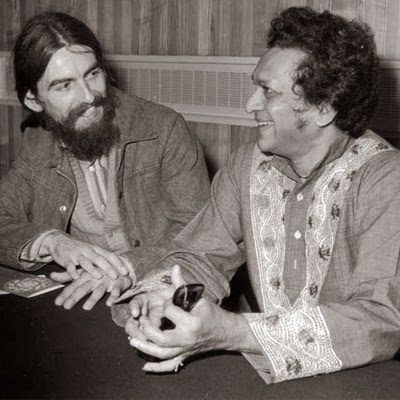
GEORGE HARRISON, LEAD GUITARIST OF BEATLES
WITH PT.RAVI SHANKAR
In the years to come, Ravi Shankar did many concerts internationally as well as in India, performed with many artistes and won numerous awards. He performed, wrote music and recorded three songs with violinist Yehudi Menuhin. He also performed with Alla Rakha who accompanied him on the tabla. He toured to many countries like Germany, U.S.A, United Kingdom and earned recognition across the world. Moreover, George Harrison became fond of Indian music and started learning Sitar with Ravi Shankar and played the sitar in the Beatle's track 'Norwegian Wood'. 
The master of Sitar gained more and more popularity with each passing year and was the pioneer in introducing the traditional Indian music to the western audiences. He grabbed many awards including two Grammy awards and also bagged an Oscar nomination for his score in the film Gandhi by Richard Attenborough. 
PT.RAVI SHANKAR WITH DAUGHTER ANOUSHKA SHANKAR
In 1997, Pandit Ravi Shankar taught his daughter Anoushka Shankar playing Sitar and later on composed music for her, toured and performed with her. His last concert was with Anoushka on November 4, 2012 at Long Beach. Shankar breathed his last on the 11th of December, 2012 in San Diego, California losing battle to some respiratory and heart ailments.  India suffered a great loss with his sad demise but he will always be remembered through his music. He was probably the only musician who experimented with and fused together Indian classic and western music.

Sunday, 6 April 2014

Chairperson Prasar Bharati Presides

   Chairperson Prasar Bharati Presides over US Embassy's  Hindi  Website Launch


The U.S. Embassy in India on 5th April,2014, inaugurated its Hindi website.  MrinalPande, Chairperson of PrasarBharati, was Chief Guest at the event, which featured remarks by U.S. Ambassador Nancy J. Powell and interactive displays highlighting the Embassy’s Hindi website (http://hindi.newdelhi.usembassy.gov/) and the Span Hindi Magazine web portal (http://span.state.gov/hi).

The launch of the U.S. Embassy’s website in Hindi is “another step forward towards linking us even deeper to India’s cultural heritage,” said Ambassador Powell. She added.  “India and the United States have a bright future”. 

“This launch reflects a bold, strategic way in which the United States is communicating and connecting with the people of India,” noted Walter Douglas, Minister-Counselor for Public Affairs at the U.S. Embassy.  The U.S. Mission is on Twitter in Hindi @USAHindiMein.

Source: http://indiaeducationdiary.in/Shownews.asp?newsid=28686

Friday, 4 April 2014

Broadcasting woes


Broadcasting woes
                         By Brigadier (R) V.A.M. Hussain
                                          
“If we are to transform India, a realist or ‘Patelist’ engagement with the rest of the world is what we must implement; engaging the world from strength while recognising reality for what it is, foreswearing hubris and belligerence”, remarked Shiv Shankar Menon during the Patel Memorial Lecture of All India Radio last year. India in effect continues with Sardar Patel appreciation against taking the Kashmir issue to the United Nations and has been successful in averting international manipulation in our internal affairs.  In the recent past, reports appeared in sections of the press that our neighbours are active in rolling controversies and possible resentment for rehabilitating surrendered militants via Nepal. Yasin Bhatkal's revelation of Nepal remaining the favoured nation for transiting members of the Indian Mujahideen further fuelled diplomatic irritation.

The most disturbing vilification campaign alleging torture of Nepalese people whipping up local sentiments and a number of FM stations with content paid up by vested interests and mixing attractive Bollywood stuff in Nepal are psy weapons that merit the nation's intervention. Gorkhas of Nepalese origin have shared triumphs and sorrowThe most disturbing vilification campaign alleging torture of Nepalese people whipping up local sentiments and a number of FM stations with content paid up by vested interests and mixing attractive Bollywood stuff in Nepal are psy weapons that merit the nation's intervention. Gorkhas of Nepalese origin have shared triumphs and sorrows battling in all theatres of operations as part of the glorious Indian Army. As of today, there seems to be no coordinated trans-border broadcast policy to air either views or the stand point of the nation. India’s National Public Broadcaster, Prasar Bharati, continues to be sub-optimally utilised.s battling in all theatres of operations as part of the glorious Indian Army. As of today, there seems to be no coordinated trans-border broadcast policy to air either views or the stand point of the nation. India’s National Public Broadcaster, Prasar Bharati, continues to be sub-optimally utilised.

After Independence and up to the eighties, the External Services Division of AIR functioned in close coordination with MEA through External Publicity Division with greater interaction between the two keeping in view foreign policy requirements, dynamics of foreign relations, and priorities set from time to time.
 
Due to its colonial links with England, AIR entered the domain of external broadcast in 1939 purely as a tool for propaganda for the allies during World War II with service in Pushto language in order to counter German Radio blitzkrieg and complement the efforts of the BBC in this region.  When the theatre of operation expanded to South East Asia and East Asia by 1945, External Services Division had a total of 22 language services.  The importance waned once the War ended, plummeting from 22 to just 10 languages. The capacity of ESD remains to cover 100 countries with coverage of 75% of world population in 16 foreign and 11 Indian languages with a targeted audience of 9 neighbouring countries comfortably.
 
But gone are the days of diplomatic bags overflowing with letters addressed by radio audiences from all over the world to External Service Division of AIR. The Urdu Service widely popular among Pakistan and at home is in a state of disarray and listeners’ feedback has become a trickle. Chinese domination in the visual and audio medium is of concern since a substantial Arunachalee tribal population living in East Syong, Tirap, Changlong, Ajnow, Lohit, Upper and Lower Dibang Valleys could access Chinese TV channels of  High Power Transmissions from Chinese territory whereas our own Doordarshan, Itanagar, covers a few kilometres through Low Power Terrestrial Transmission. However there being no impediment to satellite TV through DTH, the case for Set Top Boxes for DD free Dish is indispensable if Prasar Bharati has to prudently cover the North East. It is our national duty to reach inaccessible terrain inhabited by tribal Indians in and around Tawang who witnessed chaotic battle scenes during the 1962 operation and upper reaches near Leh, Ladakh.
 
In the changing scenario of popularity of FM channels compared to Medium Wave and Short Wave transmissions, the country needs to shift its primary broadcast to FM radio with relevant content retaining its own and traditionally loyal trans-border audience. There are more than 150 independent Radio Stations operating in Nepal. If India has to retain audience base in Nepal, augmentation of transmission power and number of FM stations is necessary as of yesterday.  As far as Bhutan, English added on to Dzonka could cover the whole population with increased presence of FM.  In times of crisis, it is AIR, BBC or Indian satellite channels which are tuned into in Pakistan for credible news; Maj Gen Mohd Azam Asif of PAK Army observed once, substantiating the relevance of AIR.
 
Coverage of regional content, news and current events for external audience could only succeed with local dialect and flavour. There is all round apathy about external radio broadcast of ESD among all stakeholders including MEA, resulting in progressive decline of our broadcast as an instrument of diplomacy relegated to the background, adversely impacting its performance, notwithstanding the historic role played.  It is unfortunate and ironic that our external broadcast is touching the nadir at a time worldwide efforts are on to re-invent the importance of external broadcast expanding and consolidating their position, adopting the newest of technologies including new media to meet the changing realities of international politics.
 
Complete dismantling or discontinuation of external broadcast may not be in the larger national interest and may turn out to be throwing the baby with the bucket of water. Credible assessment of external audience indicates decline in short wave and medium wave, suffers clarity due to concrete congestion and sky scrapers in Urban India and the neighbourhood. Simulcasting in FM, web streaming, proliferation in internet and availability in hand held devices would rejuvenate AIR. Unless ESD functions with regular interaction from stakeholders like MEA, MoD, MHA, meeting the needs of foreign policy and priorities, the vast infrastructural wealth of the nation in the hands of Prasar Bharati will continue to be wasted, risking its painful death. The nation has a duty and great opportunity to revisit and formulate an integrated policy on our external broadcast which is in the Government domain.

Source: http://www.indiantelevision.com/television/tv-channels/terrestrial/broadcasting-woes-140402

Tuesday, 1 April 2014

Words of Succour

All India Radio’s national broadcasts of live recordings from the 167th Tyagaraja Aradhana at Thiruvaiyaru brought the scent of the festival to listeners.


All India Radio, in a special programme “Ravivaria Akil Bhartiya Sangeeth Sabha”, some time back, broadcast the live recordings of two Carnatic music concerts from the 167th Sadguru Tyagaraja Aradhana Festival which was held at Thiruvaiyaru, where the saint composer Tyagaraja attained samadhi. The emphasis in the music recitals during this festival is on the compositions of Tyagaraja, through brief raga alapanas and neraval to bring out the lyrical value of these compositions. Music lovers also, who gather at the Aradhana, pay great attention to the lyrical values. Unlike in other regular concerts, the emphasis is also on the mathematics in swara singing. AIR has been broadcasting such live recordings for the past many years. The other highlight of these broadcasts is to hear the group rendering of the famous five ‘Pancharatna’ kritis — in the ragas Nattai, Gowla, Arabhi, Varali and Sri — by innumerable musicians gathered like pilgrims at the venue.

The first broadcast contained a brief vocal duet recital of Shanmukhapriya and Haripriya, (popularly known as the “Priya Sisters”), for about 45 minutes. Even in the short concert, through a careful and thoughtful selection of the compositions, the siblings provided a feeling of listening to a full-fledged concert. Many of the songs they chose are not often heard in regular concerts. They did highlight the emotive content of many of the compositions.
The Priya Sisters started their recital with “Lakshanamulu gala” in raga Suddha Saveri and ended with “Pahi Ramaduta” in raga Vasantavarali. Their rendering of the slow paced “Manamu leda” in raga Hamir Kalyani was delightful. Even in this brief recital, the duo sang “Vedalenu Kodandapani” in raga Todi and “Soumitri Bhagyame” in raga Karaharapriya in a fairly detailed manner. In the former composition, their brilliant neraval of the phrase “Vasudha bhara mellanu dirpa vedalenu kondandapani” — partly from the charanam portion of the composition and partly from the pallavi portion itself — was impressive. In the latter composition, the brief alapana of the raga, seemingly by Haripriya (as one was listening to the radio broadcast) and the brief tani avartanam by the percussionist were enjoyable. V.V. Srinivasa Rao on the violin, Patri Satishkumar on the mridangam and Madipakkam A. Murali on the ghatam provided excellent support.


In another live broadcast, B. Vijaygopal rendered Tyagaraja compositions delightfully on the flute. His recital too was of same duration as that of Priya Sisters. The opening piece “Ninnada Nela” in raga Kannada was well presented. “Nada loludai” in raga Kalyana Vasantham and “Bagayanayya” in raga Chandrajyoti were rendered very emotively. “Ramabhirama Ramaniyanama” in raga Darbar and the main piece “Etavunara” in raga Kalyani were handled very well. The main piece was preceded by a fine alapana of raga Kalyani and ended with tani avartanam. The accompanying artistes R.K Shriramkumar on the violin, B. Harikumar on the mridangam and K.V. Gopalakrishnan on the kanjira were excellent.


शाम-ए-ग़ज़ल

शुक्रवार,दिनांक 28 मार्च,2014 को आकाशवाणी की राष्ट्रीय प्रसारण सेवा,दिल्ली द्वारा भारतीय विद्या भवन सभागार में "शाम -ए-ग़ज़ल" का आमंत्रित श्रोताओं के सन्मुख आयोजन किया गया.इस कार्यक्रम में भारत के प्रसिद्ध ग़ज़ल गायक-पीनाज़ मसानी, चन्दन दास व मालिनी अवस्थी ने अपनी मधुर ग़ज़लों से श्रोताओं का मन मोह लिया.प्रस्तुत है कार्यक्रम की कुछ मधुर यादें चित्रों की ज़ुबानी-
यह हैं मालिनी अवस्थी -


यह हैं,श्रोतागण

Friday, 28 February 2014

दिनांक 25 फरवरी 2014 को आकाशवाणी की राष्ट्रीय प्रसारण सेवा, टोडापुर, नई दिल्ली दृवारा पहली बार अपने प्रांगण में "काव्य संध्या" का आयोजन आमंत्रित श्रोताओं के सम्मुख किया गया I इस आयोजन में राष्ट्रीय स्तर के प्रतिष्ठित कवियों ने भाग लिया I इन आमंत्रित कवियों के नाम थे डॉ. कैलाश वाजपेयी, बालस्वरूप राही, बलदेव वंशी, एल.डी. मंडलोई, मंगलेश डबराल, जीतेन्द्र श्रीवास्तव राम कुमार कृषक, विनोद खैतान, मिथलेश श्रीवास्तव, सुमन केसरी एवं अनामिका I इस अवसर पर राष्ट्रीय प्रसारण सेवा केंद्र के उपमहानिदेशक श्री लक्ष्मी शंकर वाजपेयी, उपनिदेशक (इंजीनियरिंग) श्री हृदेश कुमार, सहायक निदेशक डॉ. के. सी. वर्मा व् कार्यक्रम एवं इंजीनियरिंग प्रभाग के अधिकारी व् कार्यालय के समस्त अधिकारी व् कर्मचारी उपस्थित थे I इस अवसर पर उपनिदेशक डॉ. के.सी. वर्मा ने अपने स्वागत कथन में आमंत्रित कविजनों का अभिनन्दन किया I साथ ही, भविष्य में ऐसे रचनात्मक आयोजन पुनश्च करवाए जाने की इच्छा व्यक्त की I कार्यक्रम के अंत में राष्ट्रीय प्रसारण सेवा के उपमहानिदेशक श्री लक्ष्मी शंकर पाजपेयी जी ने आमंत्रित कवियों को फूलों के गुलदस्ते देते हुए सभी का आभार प्रकट किया I साथ ही, इस काव्य- संध्या को सफल बनाने पर सभी को हार्दिक धन्यवाद प्रकट किया I